












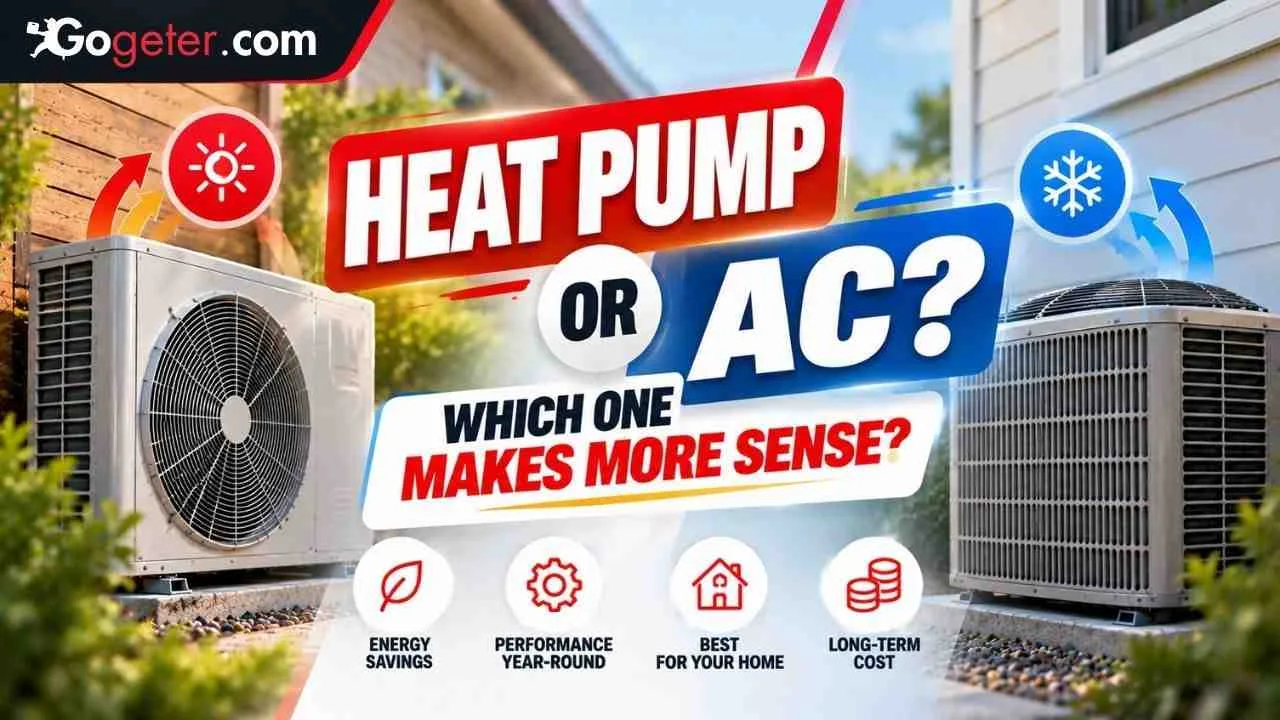
Your AC is on the cycle, and the contractor asks the question you didn’t prepare for: heat pump or air conditioner? Picking a new cooling system suddenly feels a lot harder than it should.
The debate between heat pump vs air conditioner is full of technical terms, and the price tags don’t match. What's the difference between heat pump and air conditioner systems, and which one is right for your home?
This guide explains that. You can check how each works, what costs less to run, how long they last and which best suits your climate. But here’s the best part: most homeowners never hear this. In terms of cooling, these two are pretty much the same. So what makes them so special?
Is a Heat Pump the Same as an Air Conditioner?
Almost. And that surprises most people. Both systems use the same refrigeration cycle to remove heat from your house in the summer. The only major difference between a heat pump and an air conditioner is one small part.
How an Air Conditioner Cools Your Home
An AC does not make chilly air. It transfers heat from your house to the outside. The refrigerant in the inside coil absorbs heat from your air, and the compressor moves that heat outside to be released via the condenser. That's the principle of central air, but only one way. Most homes have an AC and a furnace for winter.
What Makes a Heat Pump Different?
A heat pump does the same cycle, but with one added item that alters everything. This item is a reversing valve. It cools just like an AC in heat. In winter, the valve reverses the direction of the refrigerant, and therefore an air-source heat pump extracts heat from the outside air and carries it inside.
That's what a heat pump AC is: an air conditioner that can run backwards. It also replaces only the outdoor condenser and keeps your indoor air handler intact. That clears up the common heat pump vs condenser confusion. Here’s the Air Conditioner vs Heat Pump setup side by side:
| Feature | Air Conditioner | Heat Pump |
|---|---|---|
| Cools the home | Yes | Yes, the same way |
| Heats the home | No | Yes |
| Key extra part | None | Reversing valve |
| Outdoor unit | Condenser | Heat pump unit (replaces condenser) |
| Usual heating partner | Gas or electric furnace | Often none in mild climates |
| Ducted or ductless | Both | Both |
So they cool the same, then. The first important concern this raises: does a heat pump chill just as well, especially in heavy summer heat?
Heat Pump vs Central Air: Does a Heat Pump Cool as Well?
For those who are mostly buying things for summer comfort, this is the question that counts. The good news is, when they’re properly sized, heat pumps cool just as well as air conditioners if they have the same SEER2 rating. In the battle of heat pump vs air conditioner for cooling, neither one has an edge.
Heat Pump vs AC for Hot Climates Like Phoenix
The extreme heat is a hard challenge, but it pushes both systems equally. Any cooling system has to work harder and is somewhat less efficient if the temperature is above 110 degrees Fahrenheit.
In the discussion of heat pump vs AC for hot climates, it’s the unit’s rated working range that matters, so check that before you buy. So, is a heat pump good for hot climates? Yes. That’s why you see so many heat pumps in the Southwest. Milder winters mean they can do double duty for heating without a separate furnace.
Are Heat Pumps Quieter Than Air Conditioners?
Noise is much more dependent on the model than on the type of system. Basic single-stage devices of either type turn fully on and off, so they sound about the same. A variable speed inverter heat pump or AC runs at lower speeds the majority of the time. That makes it significantly quieter and it also controls humidity better.
Heat Pump vs AC Efficiency: Which Uses Less Electricity?
In summer, the race is nearly a draw. The real difference in heat pump vs. air conditioner energy use kicks in when winter hits, and that’s what determines which system is more efficient for your home.
SEER2 and HSPF2 Ratings Explained Simply
A pair of digits on the yellow EnergyGuide label provides you with almost all the information you need. SEER2 measures how efficiently your AC cools, like miles per gallon for your car, and higher is better.
Both consume it, so an AC and a heat pump with the same SEER2 use nearly the same energy all summer long. HSPF2 rates heat pumps by heating efficiency. When looking for the most energy-efficient HVAC choices, search for the ENERGY STAR label. This is how heat pump vs air conditioner efficiency compares throughout the year:
| Factor | Air Conditioner + Furnace | Heat Pump |
|---|---|---|
| Cooling rating | SEER2 | SEER2 (same scale) |
| Heating rating | AFUE (furnace) | HSPF2 |
| Heating energy source | Gas, propane or electric | Electricity only |
| Mild winters | Works well | Very efficient |
| Freezing winters | Steady at any temperature | Efficiency drops, backup heat needed |
| Best-fit climate | Very cold regions | Hot summers, mild winters |
Why the Heating Season Changes Everything
And that’s where the heat pump comes in. “A heat pump doesn’t create heat, it transfers heat.” According to Energy.gov, it can lower heating electricity use by around 50% over electric resistance heat, such as baseboard heaters.
So, is a heat pump more efficient than an air conditioner? Usually yes, over a whole year. The problem is that when it gets very cold, efficiency drops and the backup heat kicks in.
That’s why many cold-climate heat pump systems incorporate a furnace, a “dual fuel” response to the heat pump vs AC and furnace argument. This deficiency hardly matters in mild-winter areas. Efficiency is a nice concept in theory. But what will it cost you today and every month after?
Heat Pump vs Air Conditioner Cost: Which Is Cheaper Overall?
This is where many homeowners get stuck. Air conditioners are frequently considered less costly than heat pumps. But an AC cools only, so the fair heat pump vs air conditioner cost comparison is an AC plus a furnace against one heat pump.
Heat Pump vs AC Installation Cost: What You'll Pay Upfront
A heat pump by itself is typically a little more expensive than a new AC. But if your furnace is also nearing the end of its life, the picture changes. While you have to buy an AC and a furnace, it's like paying for 2 systems; with a heat pump, you're getting 2 in 1.
If your ducts and wiring are already in place, the heat pump vs. AC installation cost gap is usually minor, since a heat pump goes in the same position. Before you buy, check with your local utility for rebates. Here is the whole heat pump vs AC cost picture below:
| Cost Factor | AC + Furnace | Heat Pump |
|---|---|---|
| Equipment and installation | AC about $3,500–$9,500, plus furnace about $2,100–$5,200 | About $4,200–$7,600 |
| Separate furnace needed? | Yes | Often no, in mild climates |
| Summer cooling cost | About the same | About the same |
| Winter heating cost | Depends on gas or electric rates | Often lower than electric heat |
| Yearly maintenance | Two systems to service | One system, serviced twice a year |
| Lifespan | AC rests in winter | Runs year-round |
Operating Cost and Lifespan: Is a Heat Pump Cheaper to Run?
Monthly bills and system life decide the long-term winner. A heat pump's monthly cost is about the same as an AC in the summer. Winter is different. A heat pump usually costs less to run than electric resistance heat, and it can compete with gas where winters are mild. Life duration is the compromise.
In the heat pump vs. air conditioner lifespan comparison, a heat pump works all year, while an AC rests in winter; thus, many experts predict a heat pump to wear out a little earlier.
So is a heat pump cheaper than an air conditioner? Over time. Usually, the heat pump is cheaper, especially in moderate regions. Now you’ve seen how they function, cool, perform and cost. Honestly, time to compare them side by side.
Which Is Better: a Heat Pump or Air Conditioner?
As the Quick Answer suggested, no method wins in every house. So, is a heat pump better than an air conditioner? It depends on three things: how cold your winters get, how you heat your home today, and how much you want to invest upfront.
Heat Pump vs AC Pros and Cons at a Glance
There is no such thing as a free thing. Here is the honest heat pump versus air conditioner pros and cons list side by side: Heat pumps pros -
- One system for both heating and cooling
- Efficient electric heat with no gas burning inside your home
- Can totally replace an old furnace
Heat pump cons -
- More expensive than an AC alone
- Reduced efficiency in deep freezers
- Runs all year, which adds wear
AC pros -
- Lower starting price
- Less wear, all winter rest
AC cons -
- Needs separate heater or furnace in winter
What are the disadvantages of a heat pump? Mostly cost and cold weather performance. Neither is a deal-breaker in temperate climates.
Should I Replace My AC With a Heat Pump?
That’s the decision most readers come here to make, and the answer relies on what you already have. In most cases, if your AC unit is 10-15 years old, your winters are mild, and you currently heat with electric baseboards or an ageing furnace, replacing your AC with a heat pump is a good move.
You can upgrade your heating and cooling all at once. But if you’re in a cold climate with a recent gas furnace, it’s often better to keep a standard AC, and the dual-fuel system we talked about before is a compromise. Still asking, should I get a heat pump or air conditioner? Find your situation below:
| Your Situation | Best Choice | Why |
|---|---|---|
| Hot summers, mild winters (e.g. Phoenix) | Heat pump | Cools and heats in one system |
| Very cold winters | AC + furnace or dual fuel | Steady heat in freezing weather |
| Newer gas furnace installed | AC | Keep the furnace, replace only the cooling |
| Electric heat only | Heat pump | Uses far less electricity to heat |
| Tight budget, cooling only | AC | Lowest upfront price |
| AC 12+ years old and failing | Heat pump (if winters are mild) | Upgrades cooling and heating at once |
| Home without ducts | Ductless heat pump | Mini-splits need no ductwork |
The only factor that determines whether the right system delivers on its promise is how you scale and use it.
Before You Buy: Sizing and Finding the Right HVAC Pro
Here’s the hard way many customers learn it: the proper HVAC system, installed poorly, will perform worse than the wrong one, installed well. The quality of the sizing and artistry determines how well the heat pump installation or new AC installation will operate.
How to Size a Heat Pump or AC for Your Home
Bigger is not better. If your unit is too large, it can make your home uncomfortable. Both systems are rated in tonnes, and one tonne is 12,000 BTU of cooling per hour. A load calculation (known as Manual J) tells you the proper size of your heat pump or AC.
It accounts for your square footage, insulation, windows, and sun exposure. Without it, a unit that is too big will short-cycle, waste energy, and make your home humid.
Find Trusted HVAC Installers Near You
Before you commit to someone, consider the pros. On GoGeter, you can compare local HVAC pros by reviews and price in one place. Get a documented price and a proper load calculation from each HVAC installer, and review our guide to red flags when hiring before you sign.
A/C out in the middle of summer? Looking for AC repair near me? GoGeter can help you get a pro available today. Some questions homeowners still ask, answered quickly before you book.
Heat Pump or AC: Making the Right Choice for Your Home
When it comes to cooling, the decision between a heat pump vs air conditioner is closer than most people think. Both will do just as good a job of cooling your home in the heat. The key difference is that a heat pump also heats. And how much that added capability is worth depends on your environment.
Remember the surprise at the beginning, that these two are practically the same machine? That one more thing: the reversing valve, and that’s it now for your entire selection. In mild-winter, hot climates, a heat pump generally gives you more bang for your buck.
If you live in a colder climate with a newer furnace, a traditional AC may still be the better investment. Next, from here, it’s straightforward. Go back to the “which fits your home” table, think about your winters and how you heat your home today and ask for a proper load calculation before you choose.
Next time a contractor asks, “heat pump or AC?” you won’t feel stuck. You will know just what to answer and why. Ready to pick your new cooling system? Compare & Book a trusted HVAC pro today on GoGeter.
Discussion 0
Comments are open to signed-in members soon.