













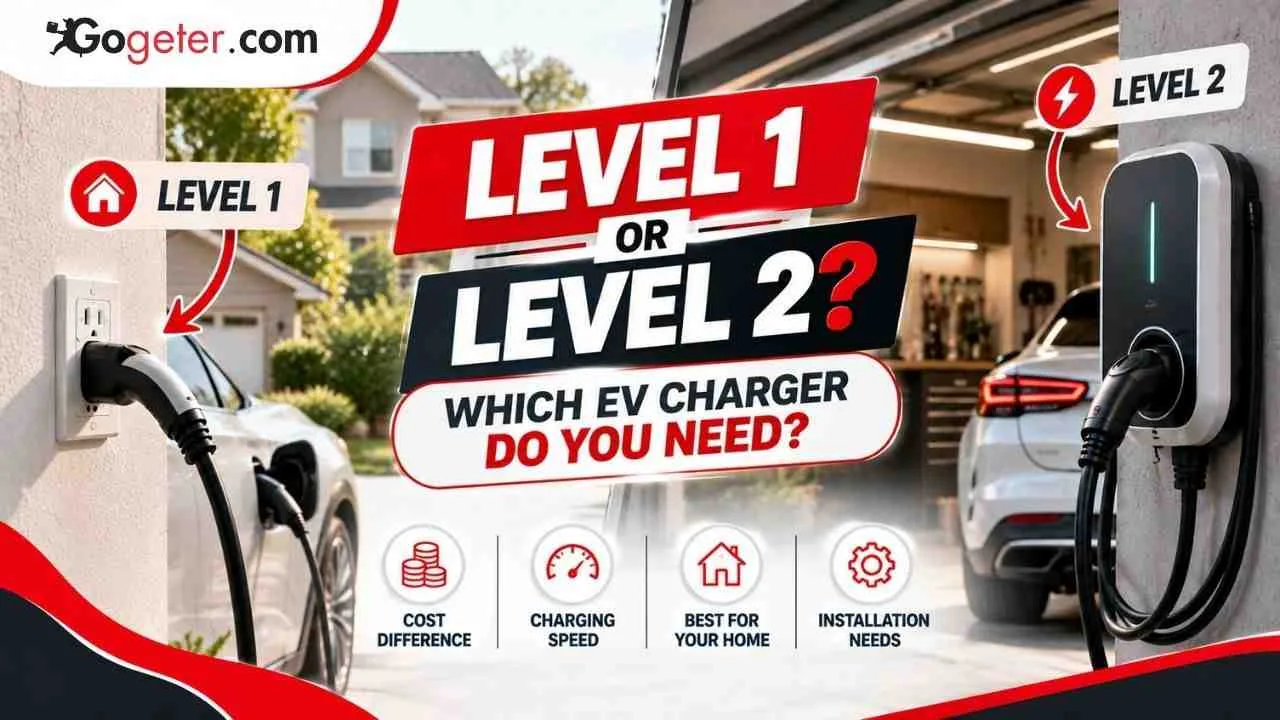
Your new EV came home with a charging cord. You plug it into the garage outlet, and by morning the battery has gained a little range. Now you're wondering if a standard outlet is enough or if you need a faster setup.
This is where the Level 1 vs. Level 2 EV charger question comes in. A Level 1 charger uses the regular 120-volt outlet you already have. A Level 2 charger runs on a dedicated 240-volt circuit and charges much faster.
So, is Level 1 or Level 2 charging better for your home? Faster doesn't always mean better. When it comes to EV charging level 1 vs. level 2, the right pick depends on how far you drive, where you park, and what your electrical panel can handle. When you're ready for Level 2, you can find licensed EV charger installers on GoGeter.
First, here's what each charging level actually is.
What Is a Level 1 vs. Level 2 EV Charger?
Both chargers do the same basic job. They send AC power from your home into your car, and both plug into the same charging port. The difference between Level 1 and Level 2 EV chargers comes down to voltage, and voltage determines how fast your battery fills up.
How Does a Level 1 Charger Plug Into Your Home?
A Level 1 charger is usually the cord that came with your EV. One end plugs into your car, and the other goes into a regular 120-volt household outlet. There's nothing to install.
What power does a Level 1 EV charger use? It draws about 1.4 to 1.9 kW. That's close to what a space heater uses, but your car draws it for hours at a time.
That long, steady draw is why a dedicated outlet works best. If the plug feels warm or you smell burning, unplug the cord and stop using that outlet. Those are signs you need an emergency electrician.
Where Does a Level 2 Charger Get Its Power?
A Level 2 charger runs on a dedicated 240-volt circuit. It's the same kind of circuit that powers an electric dryer or range. What power does a Level 2 EV charger use? It ranges from about 3.3 to 19.2 kW. Most home units sit between 7 and 11.5 kW, several times what a Level 1 cord delivers.
Level 1 and Level 2 EV charging also use the same connector, so your car doesn't need any new equipment to make the switch.
Here's a quick look at how a Level 1 EV charger compares to a Level 2 EV charger at home.
| Feature | Level 1 | Level 2 |
|---|---|---|
| Voltage | 120 volts | 208–240 volts |
| Typical power | 1.4–1.9 kW | 3.3–19.2 kW (most home units 7–11.5 kW) |
| Outlet or circuit | Standard household outlet, ideally on its own circuit | Dedicated 240-volt circuit, usually a 40–60 amp breaker |
| Equipment | Portable cord set, often included with the car | Wall-mounted unit or 240-volt plug-in charger |
| Connector to car | Standard J1772 or NACS port | Same port as Level 1 |
| Installation | Usually none | Licensed electrician, often with a permit |
In short, your car and its plug stay the same whether you use Level 1 or Level 2 EV charging. What changes is the power coming from your home.
When you compare a Level 1 charger vs. a Level 2 charger, that power gap matters most for speed. So how much faster does Level 2 actually charge?
Which Charges Faster, Level 1 or Level 2?
Most drivers don't think in kilowatts when they plug in. They think in miles. That's why Level 1 vs. Level 2 EV charger speed is usually measured in miles of range added per hour.
How Many Miles Do Level 1 and Level 2 Add in an Hour?
With EV Level 1 vs. Level 2, the gap shows up clearly on your dashboard. Here's roughly how much range each setup adds in one hour:
- Level 1 cord: about 2 to 5 miles.
- Standard Level 2 charger: about 10 to 25 miles.
- High-amp Level 2 unit: 40 miles or more.
How much faster is a Level 2 EV charger than Level 1? In most homes, it's about 5 to 10 times faster. The exact number depends on your charger and your car.
Does Your EV Limit Level 2 Charging Speed?
Your car has a built-in onboard charger, and it sets the top speed. An 11.5 kW wall unit can't push more power than a 7.2 kW onboard charger accepts. So check your car's rating before you pay for a high-amp unit it can't fully use.
The same limit applies at a public Level 2 charging station. Speeds there match what you'd get at home, which makes them handy at work or while you shop. The gap between Level 1 and Level 2 charging is clear. For most drivers, though, the bigger question is whether the slower option still fits their daily routine.
Can Level 1 Charging Keep Up With Your Daily Drive?
A night on a Level 1 cord adds a set amount of range, usually 20 to 50 miles. Whether that's enough depends on how far you drive each day. Here's how Level 1 vs. Level 2 chargers compare for EV owners across common driving habits.
How Far Overnight Charging Gets You
| Daily Driving | Level 1 (10 hours overnight) | Level 2 (10 hours overnight) | Better Fit |
|---|---|---|---|
| Under 30 miles | Adds about 20–50 miles, covers the day | Far more than you need | Level 1 |
| 30–50 miles | Just covers it on a good night | Covers it with room to spare | Either, Level 2 for buffer |
| 50–80 miles | Falls behind over the week | Refills in a few hours | Level 2 |
| 80+ miles or rideshare driving | Can't keep up | Handles it overnight | Level 2 |
| Plug-in hybrid | Full refill most nights | Faster than needed | Level 1 |
Who Can Get By on a Standard Outlet?
Level 1 works well for plug-in hybrid owners and anyone with a short commute. It also suits a second EV that stays home most days, or drivers who can charge at work. For these drivers, a nightly plug-in usually keeps the battery topped up without any upgrade.
When Does a Level 1 Charger Start Falling Short?
Is Level 1 EV charging enough for daily driving? For most people driving under about 40 miles a day, yes. Past that, you start losing a little range each night. Long commutes and skipped charging nights widen that gap.
Arizona summers add to it, since your car uses some power to cool the battery while it charges. A Level 1 cord on a shared circuit can also keep tripping your breaker when other appliances run at the same time.
With EV charging, Level 1 vs. Level 2, these limits are what push many drivers toward an upgrade. If your miles land in the Level 2 rows, the next step is checking whether your home is ready for it.
Should You Upgrade to a Level 2 Charger at Home?
An upgrade starts to make sense when charging time begins shaping your day. If you plan errands around your battery level, Level 1 is no longer keeping up. Most homeowners weigh a Level 1 vs. Level 2 charger at home after a few weeks of real driving.
Do I need a Level 2 charger at home? Not always. You need one when a night on Level 1 can't refill what you drive each day.
Is Your Electrical Panel Ready for Level 2?
Before you book an install, it helps to know what your home can handle. An electrician will usually look at these points:
- Panel size: 100-amp panels often run tight, while 200-amp panels usually have room.
- Breaker space: an open slot for a new double-pole breaker.
- Distance: how far the panel sits from where you park.
- Existing loads: an AC, pool pump, or electric dryer already drawing power.
- Mounting spot: a garage wall or outdoor spot, and how much direct sun it gets.
If your lights dim when big appliances kick on, your panel may already be strained. That's a common reason house lights flicker, and you may need an electrical panel upgrade before adding a charger.
What If You Rent or Park Outside?
Renters need landlord approval before adding any new circuit. A plug-in Level 2 charger works well here, since you can take it with you when you move. If you park outside, choose a weather-rated unit and check your HOA rules first. Choosing between a Level 1 and Level 2 EV charger at home also means looking at the numbers. Once you know your home can handle it, the next question is what it will cost.
Is a Level 2 Charger Worth the Extra Cost?
Level 1 costs almost nothing to start. Level 2 costs more upfront, but it saves you time every day after. Most full Level 2 setups land between $800 and $2,500. Here's how Level 1 vs. Level 2 home EV charging costs compare.
Level 1 vs. Level 2 Home Charging Costs
| Cost Item | Level 1 | Level 2 |
|---|---|---|
| Charger hardware | Usually included with the EV | About $300–$800 |
| Installation labor | $0 if the outlet is ready; a few hundred dollars for a new dedicated outlet | About $400–$1,500 |
| Panel upgrade (if needed) | Rarely needed | About $1,500–$4,000 |
| Permit | Usually none | Often $50–$300, depending on your city |
| Electricity | Same rate per kWh, a little more energy lost | Same rate per kWh, slightly more efficient |
| Rebates | Rarely available | Some utilities offer rebates |
Your panel usually decides where you land in that range.
Does Level 2 vs Level 1 Charging Change Your Electric Bill?
Not by much. You pay the same rate per kWh either way. Charging at night on off-peak rates makes a bigger difference than the level you use. If your bill keeps climbing anyway, other home problems may be driving it up.
Are There Rebates for Home EV Chargers?
Some utilities, like SRP and APS in the Phoenix area, have offered rebates or EV rates. Programs change often, so check your utility's website before you buy. With a Level 1 vs. Level 2 electric car charger, the extra cost often pays off in time saved. If the numbers work for you, here's what the installation process looks like.
Planning a Level 2 EV Charger Install at Home?
Most Level 2 installs take a few hours once the permit is in place. The electrician runs a new circuit from your panel, mounts the charger, and tests it before leaving. Can you install a Level 2 EV charger at home? Yes, in most homes. Since it involves a new 240-volt circuit, it's a job for a licensed electrician, not a DIY project.
Before you book, check that your installer offers:
- A verifiable electrician license.
- A load calculation included in the quote.
- Permit handling done by them, not you.
- A written warranty on labour.
- Reviews from real local customers.
These checks help you steer clear of common red flags when hiring a home service pro and fake reviews. You can compare licensed pros in Electrical Services on GoGeter.
Do You Need a Permit for a Level 2 Charger?
Most cities require a permit for a new 240-volt circuit. Your installer should pull it for you and book the inspection once the work is done. The job follows NEC Article 625, the national code for EV charging equipment. It limits a charger to 80% of its circuit, so a 50-amp circuit supports a charger running at 40 amps.
Should You Hardwire or Plug In Your Charger?
A hardwired charger connects straight to the circuit. It looks cleaner, supports higher amps, and works well for outdoor mounting. A plug-in charger uses a NEMA 14-50 outlet, so it can move with you.
Just make sure that outlet is heavy-duty and EV-rated, since cheaper ones can overheat during long charging sessions. Every Level 1 vs. Level 2 car charger setup has its own strengths and trade-offs. Here's how they compare side by side.
Level 1 vs Level 2 EV Charger Pros and Cons
At home, you're really choosing between three setups. A Level 1 cord, a plug-in Level 2 charger, and a hardwired Level 2 unit each fit a different kind of driver and home. The right pick depends less on speed and more on how you drive, how long you plan to stay, and how much you want to spend upfront. Here's how the Level 1 vs 2 EV charger options stack up.
Pros and Cons of Each Home Charging Setup
| Setup | Main Advantages | Main Drawbacks | Best Suited For |
|---|---|---|---|
| Level 1 cord on a 120V outlet | No install cost, portable, works almost anywhere | Very slow, can trip a shared circuit | Plug-in hybrids, short commutes, backup charging |
| Level 2 plug-in (NEMA 14-50 outlet) | Fast, can move with you | Needs a new 240V outlet rated for heavy use | Owners who may move, renters with landlord approval |
| Level 2 hardwired wall unit | Fastest home option, clean install, good for outdoor mounting | Higher upfront cost, stays with the house | Long commutes, two-EV households |
Level 1 wins on cost and simplicity. It's the easy choice if you drive a plug-in hybrid or keep your daily miles low, and it doubles as a handy backup when you travel.
Level 2 wins on speed and convenience. The plug-in version gives you flexibility if you might move, while the hardwired unit suits busy households that need a full battery every morning.
Either way, the Level 1 charger vs. Level 2 charger choice comes down to upfront cost versus daily convenience. So which one should you pick for your home?
Which EV Charger Is Better for Your Home, Level 1 or Level 2?
For most full-electric drivers, Level 2 is the better long-term fit. It refills the battery overnight, so your car is ready each morning. Level 1 still makes sense for lighter driving. If you own a plug-in hybrid or drive only a short distance each day, a standard outlet can meet your needs at no extra cost.
Not Sure Whether Level 1 or Level 2 Fits Your Driving?
Choosing a Level 1 or Level 2 EV charger gets easier when you consider your routine. A few quick questions can point you the right way:
- How many miles do you drive on a normal day?
- Do you park in a garage, driveway, or on the street?
- How old is your electrical panel?
- Is your car a full EV or a plug-in hybrid?
If you drive more than 40 miles a day, park in a garage, and have a newer panel, Level 2 is likely the right call. Lighter drivers with older panels may do just fine on Level 1 for now.
Thinking About a Second EV Down the Road?
A second EV changes the math. Two cars sharing one Level 1 outlet will struggle to stay charged through the week. If another EV is likely in the next few years, ask your electrician to size the Level 2 circuit for it now.
Planning ahead can save you from paying for a second install later. The Level 1 vs. Level 2 EV charger decision comes down to your miles, your panel, and your plans. Once you've picked your level, the last step is finding the right person to install it.
Ready to Book a Level 2 Charger Installer Near You?
Level 1 works well for plug-in hybrids and light daily driving. For most full EVs, though, Level 2 is the setup that keeps up with real life, giving you a full battery each morning without planning your day around the outlet.
If you're ready to make the switch, a good installer keeps the process simple. A licensed electrician will check your panel, handle the permit, and set up a charger that fits your home and your car.
On GoGeter, you can compare licensed EV charger installers in your area, read real reviews, and request quotes in one place. Still have questions about charging speed, outlets, or costs? You'll find quick answers in the FAQ section below.
Discussion 0
No comments yet — be the first to share a thought.