










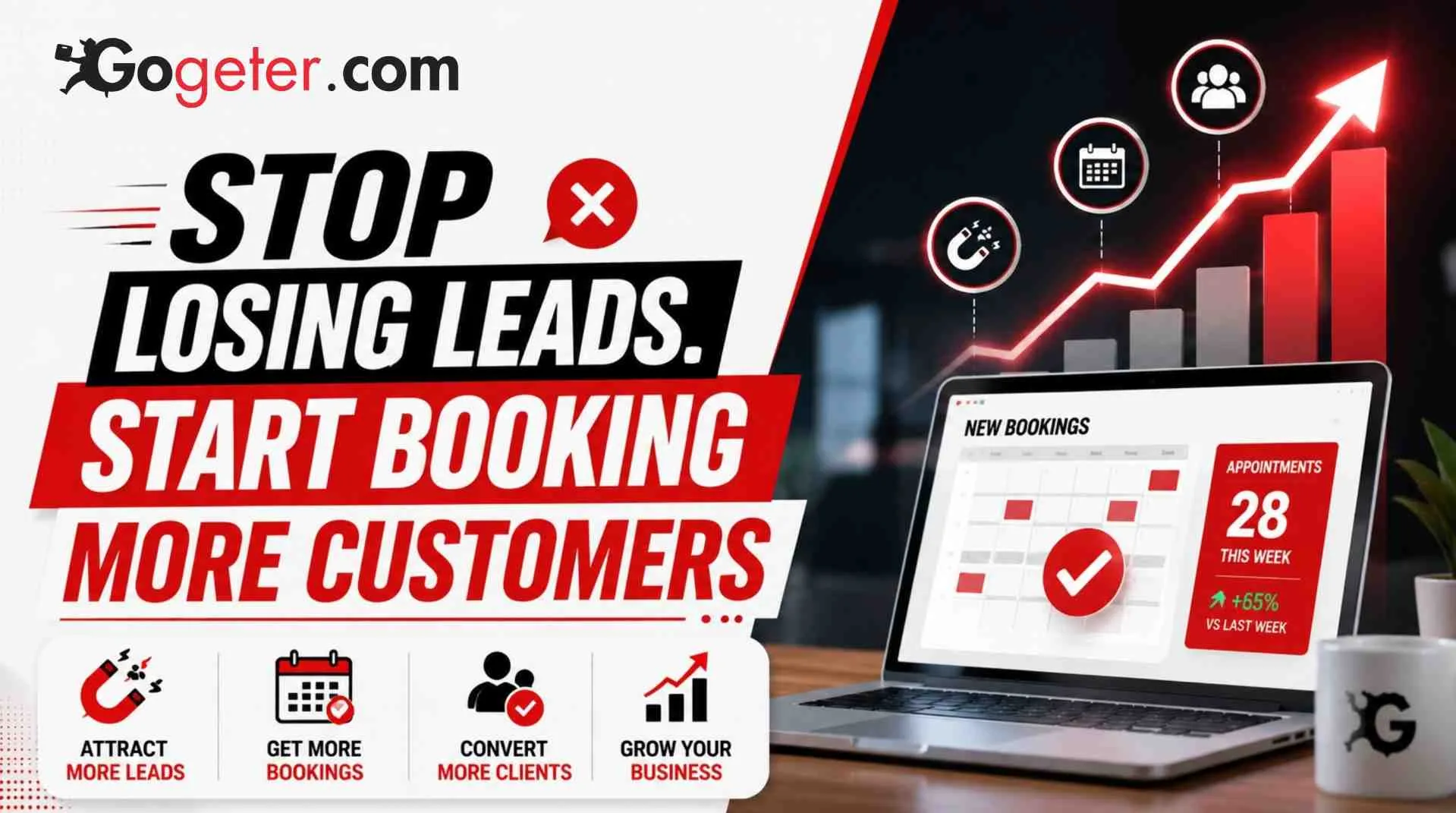
Most people who work in service don't need more leads. They need to convert service inquiries into bookings that show up on the calendar. The phone rings while you're working. At nine o'clock at night, a form comes in. You mean to call back, but the week goes by quickly. That gap is where the money goes.
You can pay good money for home service leads and still watch your confirmed bookings stay flat. Service business leads are only worth what you do with them in the first few hours. Booking conversion is not a marketing problem. It is an operations problem, and it is one of the few things you control completely.
The good news is that the fixes are small and mostly free. But before you fix anything, it helps to know where the inquiries are actually going.
Why Do Service Inquiries Stop Before They Become Bookings?
Most home service marketing money goes into getting the phone to ring. That part usually works. The harder part is what happens next, because your booking rate is set by how you handle a lead once it arrives, not by how many arrive.
What Happens to an Inquiry You Don't Answer the Same Day?
Someone with a dead outlet or water on the floor is not sitting around waiting. They have usually contacted two or three pros in the same ten minutes, and whoever answers first tends to get the job. Most service businesses that track their numbers find the loss happens in the first hour, not the first week. By the next morning, the work is often already scheduled with someone else. Nothing was wrong with the lead. It just went cold while you were busy.
Is It a Lead Problem or a Follow-Up Problem?
It's almost always a problem with following up. Before anything else, professionals tend to blame bad leads. But the same leads that don't work for one business get booked by another that same afternoon. What makes them different is what happens after the inquiry lands.

Inquiry to booking runs through five points, and a break at any one of them ends the job:
- First contact: Nobody replied quickly enough, and the customer moved on.
- Qualification: You spent an hour on a job that was never a fit for you.
- The quote: The price went out with no explanation attached.
- Follow-up: You reached out once, heard nothing, and let it go.
- Confirmation: The customer said yes but never got a clear next step.
Only the first one is even partly a lead problem. The other four are entirely yours to fix, which is better news than it sounds. Better service request conversion comes from finding which of the five is costing you the most, and for most pros, that is the reply.
How Fast Should You Respond to a Customer Inquiry?
Faster than feels necessary. Inquiry response time is the cheapest thing to fix in your whole operation, and it usually moves more revenue than anything else you could change this month.
Why Does the First Business to Reply Usually Win the Job?
Because by the time you call back, the customer has often stopped looking. Sales researchers have studied this pattern across industries, and it holds nearly everywhere: the first business to respond to customer inquiries wins a disproportionate share of the work, regardless of price or reviews. The search ended because someone offered to handle the problem, not because they were the better pro.
Speed also carries a signal. A fast response to leads suggests you are organised and have room in the schedule. A slow one raises the opposite question before you have said a word.
| Response Window |
Customer Mindset |
Your Realistic Odds |
|---|---|---|
| Under 5 minutes |
Still on your page, problem front of mind |
Strong. Often the only pro they speak to |
| Under 1 hour |
Comparing two or three options |
Good. You are usually first or second in. |
| Same day |
Waiting, but starting to look elsewhere |
Fair. Depends who reached them earlier |
| Next day |
Has likely spoken to someone already |
Weak. You are now the backup quote |
| 48 hours or more |
Job is often booked or shelved |
Poor. Worth a try, not worth a plan |
All of this doesn't mean you should put down your tools every time the phone rings. It means the first answer comes quickly, even if the real talk comes later.
How Do You Reply Fast When You're On a Job Site?
You send a holding reply, not a full answer. A missed call or one you cannot take should get a text within minutes saying when you will call them back. A web form should trigger an automatic acknowledgement, then a real message from you the same day. A text deserves a text back with one qualifying question attached, something like "Happy to help with that. Is the whole unit down or just one room?" Marketplace inquiries need the fastest reply of all, since the customer is looking at other professionals on the same screen. That alone will increase the booking conversion rate. But speed only pays if the inquiry was worth answering.
How Do You Qualify Service Inquiries Without Losing Them?
You ask less than you think you need to. Most pros either skip qualification entirely or turn it into an interview. The goal is to qualify service inquiries in about ninety seconds without making the customer feel processed.
Which Three Questions Filter a Lead Fastest?
Three questions will sort most customer service inquiries before you have spent any real time on them:

- What exactly is happening, and when did it start? Tells you the scope and whether it is urgent.
- Where is the property? Tells you whether the drive time makes the job worth taking.
- When do you need this done? Tells you if they are ready to book or still thinking.
Ask them in that order. Starting with the problem shows that you are paying attention, so the other two come off as helpful instead of screening. Qualifying leads works better when it feels like the beginning of the work and not like a test the customer has to pass.
How Do You Tell a Serious Inquiry From a Price Shopper?
Serious customers describe a problem. Price shoppers describe a job. Someone who opens with what is wrong is usually ready to book. Someone who opens with "how much for a panel upgrade" is often collecting numbers, and homeowners are increasingly told to gather several quotes and watch for warning signs and red flags before they commit.
That does not mean writing them off. Nurture service leads that are not ready yet with one honest reply, a follow-up later, and a fair share of prospects convert into customers a few weeks on. Either way, what you say in that first reply decides most of it.
What Should You Actually Say in Your First Reply?
Something that could not have been sent to anyone else. Personalised responses take no longer to write than templates- just one extra line of attention, and that line is usually what turns a request into a booking.
What Makes a Reply Feel Personal Instead of Templated?
The difference usually comes down to one detail. Homeowners always say that a reply that names their particular problem comes across as knowledgeable, while a generic template comes across as spam. People who wrote in about a switch that goes off when the dryer is on should have the dryer mentioned in the answer. That little thing shows that you read the message and know what it's about.
Beyond that, good customer communication in a first reply confirms you understood, sets a clear next step, and leaves pricing for when you have enough information to be accurate.
| Element |
Generic Version |
Converting Version |
|---|---|---|
| Opening line |
"Thanks for your inquiry." |
"Thanks for reaching out about the breaker." |
| Problem reference |
None. Straight to availability |
Names the symptom and the usual cause. |
| Price handling |
"Our rates start at $X." |
"I will confirm once I see the panel." |
| Next step |
"Let me know if interested." |
"Thursday morning or Friday afternoon?" |
| Sign-off |
Company name only. |
Your name, your number, a line about being reachable. |
Neither version takes longer than two minutes. The one on the right converts inquiries into customers because it reads like someone who already understands the job.
Should You Send a Quote or Ask for a Call First?
It depends on what you already know. If the customer has described a standard job clearly, send a range and a booking slot in the same message, since making them wait for a number does not improve customer experience. If the job could go three ways depending on what you find, say so and ask for five minutes on the phone. What you should not do is send a bare number with no context. That is where the price conversation usually goes wrong.
How Do You Handle Price Objections Without Dropping Your Rate?
More inquiries die here than anywhere else in the chain. The instinct is to discount, but a price objection is rarely about the number. It is about whether the number makes sense yet.
What Do You Say When Someone Says You're Too Expensive?
Ask what they are comparing it to. That single question does more for sales conversion than any discount, because it usually reveals that the other quote covers less work. Most homeowners are not negotiating. They are trying to understand why two pros quoted differently for the same job.
Explaining the gap is what builds customer trust. If your price includes a permit, a warranty, or materials the cheaper quote left out, say so plainly. Customers who never hear the explanation just assume you are expensive.
| What They Say |
What They Actually Mean |
What You Say Back |
|---|---|---|
| "That's too expensive." |
I don't know what I'm paying for |
"Happy to walk through what's included. What were you expecting?" |
| "I got a cheaper quote." |
Help me compare these properly |
"Does theirs cover the permit and warranty? Worth checking." |
| "Let me think about it." |
Something is unresolved |
"Of course. Is it the timing or the price you're weighing?" |
| "I'll check with my spouse." |
Genuine, or a soft exit |
"Sure. Want me to send this in writing so you both have it?" |
| "Can you do it for X?" |
Testing whether the price is real |
"Not at that number, but I can adjust the scope if that helps." |
None of these drop your rate. They keep the conversation open long enough to turn leads into paying customers who understand what they bought.
Do Reviews and Job Photos Justify a Higher Price?
They do, but only the specific ones. A star rating tells a homeowner very little. What moves a decision is proof they can picture:
- A picture of work that looks like this. The fact that you rewired a panel last month says it all.
- A review that calls out a behaviour by name. "Arrived when he said he would" is better than five stars with no feedback.
- From the same street, a "before" and "after." Impressive and far away are less important than local and recent.
Attach one relevant example to a quote sitting above a competitor's, and the number stops looking arbitrary. This is the cheapest way to convert leads into bookings at your real rate. Even so, plenty of customers who accept the price still go quiet, and that is a separate problem.
How Many Times Should You Follow Up on an Inquiry?
Five, spread across two weeks. Most professionals stop at one, which is why so much lead follow-up goes to waste. The jobs are not lost at the quote. They are lost in the silence afterwards.
When Does Follow-Up Start Feeling Like Pestering?
When there is nothing new in the word, people stop answering the line that says "Just checking in" because it tells them to start talking again. Every touch should give them something new, like a new spot, an answer to a question they asked, or a reminder that the quote ends soon.
Spacing matters too. Same day, then two days, then a week apart reads as attentive. Three messages in one afternoon is what pros are afraid of when they decide not to follow up with inquiries at all.
| Touch |
Timing |
Channel |
Message Angle |
|---|---|---|---|
| 1 |
Same day |
Same channel they used |
Confirm the quote landed, offer a slot |
| 2 |
Day 2 |
Text |
Answer anything they left open |
| 3 | Day 5 |
Phone |
Quick call, no voicemail script needed |
| 4 | Day 10 |
Email or text |
Availability update or scope option |
| 5 | Day 14 |
Text |
Clean close-out |
Four of those take under a minute to send. That is the whole cost of turning an enquiry into a booking on jobs you already earned.
What Should Your Last Follow-Up Message Say?
Make it easy for them to leave. Something like "I'll assume you're sorted on this one. If it comes back, you have my number." It's an honest way to end the loop, and a lot of people respond to it when nothing else did.
Follow-up on bookings can turn questions into bookings even after you've already written them off for weeks. But none of that matters if the booking step itself is where people give up.
Is Your Online Booking Process Costing You Jobs?
You can do everything above right and still lose the job at the last step. A clumsy online booking process undoes a good reply, and most pros never see it happen.
How Many Form Fields Are Too Many?
More than five. Every extra field costs you service business bookings, especially on a phone at night. Cut anything you can ask later:

- Name, number, location, issue, and time. That's the whole form.
- Take away the dropdowns. A blank text box is better than a list of service categories that no one reads.
- Kill a "how did you hear about us." It's useful for you but not for them, and it should come after the booking.
- You can skip the phone number if you have email. You want the people who will only give one, not both.
Fewer fields will increase bookings on their own, because the form stops being a decision.
What Should a Booking Confirmation Include?
Four things: the date and time window, the address you are coming to, what the visit covers, and a number they can reach you on. Send it within minutes, not hours. A vague booking confirmation is where a yes quietly turns back into a maybe, and it is the cheapest place to convert enquiries into bookings that actually happen. Once the process holds, the only question left is whether any of it is working.
How Do You Measure and Improve Your Booking Conversion Rate?
You cannot improve booking conversion if you have never counted. Service businesses that log every inquiry, including the ones that go nowhere, tend to find their weak stage within a month.
What Should You Review Every Week?
The time is the same every week: five numbers, fifteen minutes. It's not about being exact. It's being aware of the week when your average response time doubled or the month when your quotes stopped coming in while you can still change things.
| Metric |
How to Calculate |
Healthy Direction |
Fix If It Slips |
|---|---|---|---|
| Inquiry-to-booking rate |
Bookings ÷ inquiries |
Climbing, or holding steady |
Start at the reply, not the ad spend |
| Average response time |
Total reply time ÷ inquiries |
Falling toward minutes |
Set up a holding text |
| Follow-up completion |
Inquiries with 3+ touches ÷ total |
Most of them |
Put the cadence in your calendar |
| Quote acceptance |
Quotes accepted ÷ quotes sent |
Steady |
Add context to the price, not a discount |
| No-show rate |
Missed jobs ÷ confirmed jobs |
Near zero |
Send a reminder the day before |
Track these for a month and your weakest stage becomes obvious. That is the whole of home service bookings strategy: find the leak, fix one thing, count again. Good booking strategies for service businesses are not complicated, and none of this requires more ad spend. It requires answering faster and following up longer than you do now, which is how most pros turn enquiries into paying clients and increase service business revenue without adding a single lead.
Starting from a verified GoGeter profile helps, since those inquiries arrive already knowing your work.


Discussion 0
No comments yet — be the first to share a thought.